Understanding the Power of Attorney: A Guide for Everyone
The law gives everyone the right to make their own decisions. This is especially true in matters such as finances, estate planning, and health. However, when a person physically or mentally cannot make their own decisions for certain matters, they can appoint someone to handle these for them.
This legal instrument is called a power of attorney (POA). It can be used for simple matters, such as delegating someone to deposit checks or sign a form on their behalf. However, it can also cover major decisions, such as making major financial decisions, estate planning, or refusing medical treatment on one’s behalf while they’re incapacitated.
While the power of attorney definition has changed over time, it can be useful for matters such as estate planning. Here is what everyone should know about using power of attorney for their and their family’s best interests.
Decoding the Power of Attorney: What Is It and What Does It Cover?
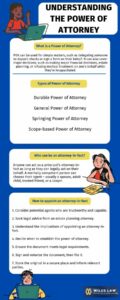
What decisions an agent can make or what their scope covers depends on what is stated on the POA. A general POA has broader legal authority to act and make decisions on behalf of the principal. On the other hand, limited POAs only allow the attorney-in-fact to make decisions during a certain time or for certain situations.
Types of Power of Attorney
There are several types of POAs, each serving specific purposes. They can be classified based on the principal’s capacity or the attorney-in-fact’s scope.
Capacity-Based Powers of Attorney
These POAs are based on the principal’s physical and mental capacity to make decisions:
- Durable POA: A durable power of attorney allows the agent to act on the principal’s behalf even after the principal is incapacitated. In South Carolina, durability is presumed, so POAs are automatically considered durable.
- General POA: Also known as a non-durable POA, this allows an agent to act on the principal’s behalf only if the principal is capable of making decisions. If a principal is incapacitated, the POA ends.
- Springing POA: Also known as standby POA, the agent can only act on behalf of the principal if they are incapacitated.
Scope-Based Powers of Attorney
These POAs are limited to a specific task or situation. This can range from a general POA for one simple task to a durable POA handling all financial and estate trust matters.
The most common scope is the medical power of attorney. Also known as a healthcare proxy, this authorizes the attorney-in-fact to make medical decisions on behalf of the principal if they cannot do so themselves. It is an essential component of advanced healthcare planning.
Who Can Be an Attorney-in-Fact?
Anyone can act as a principal’s attorney-in-fact as long as they can legally act on their behalf. A mentally competent person can choose their agent – usually a spouse, adult child, trusted friend, or a lawyer.
South Carolina laws allow principals to appoint co-agents, though this could lead to potential conflict if both agents do not agree on certain matters. Alternatively, one could name a secondary POA if the primary agent is unable to fulfill the role.
When and How to Appoint an Attorney-in-Fact
While a person can name anyone their POA, it is important to consider factors such as a potential agent’s trustworthiness, experience, and ability to handle the role. For example, if a person authorizes their friend to manage their finances and estate planning, that friend should ideally have relevant financial experience to act in the principal’s best interests.
Deciding when to establish a POA is a personal choice that should be made with careful consideration. Before creating a POA, a person should understand the implications of granting someone the authority to manage their affairs. Depending on the document, this could affect their health and well-being, their financial stability, and the interests of their immediate family.
Any adult in South Carolina can create a power of attorney at any time, as long as it fits the legal requirements. It can be approved when needed, such as giving someone a power of attorney to sell their property, or it can be set up for the future, such as a springing POA if someone becomes incompetent. It must meet the following requirements to be valid:
- Principal’s Mental Capacity: The principal must have the mental capacity to make a contract.
- Witness: A POA must be signed by the principal and attorney-in-fact in front of two adult witnesses.
- Notarization: In South Carolina, POAs must be notarized to be considered valid.
- Record: After signing and notarizing the POA, the principal must file it in the register of deeds (land records office) of their county.
To ensure one understands the consequences and implications of a POA, it’s best to discuss their case with an attorney. While some cases can vary, these are the general steps of making a POA:
- Consult a Lawyer: The principal should seek guidance from an experienced estate planning attorney to ensure the power of attorney is drafted correctly and aligns with their objectives.
- Sign the POA: The principal and the attorney-in-fact must sign the POA before two witnesses. The POA is then notarized.
- File the POA: The principal should file a copy of the POA in their county’s register of deeds. This is required by some institutions for durable POAs to be considered valid, if the principal is incapacitated.
- Shared and Stored: The original must be kept in a safe storage area accessible by trusted individuals. If the principal is incapacitated, their immediate family or the agent may need the original POA to prove they can act on their behalf. If this is a financial POA, some banks can be provided with a copy to minimize hassle when the agent must transact on the principal’s behalf.
Navigating the Responsibilities and Limits of a POA
While a POA grants significant authority to the attorney-in-fact, it also comes with responsibilities and limits.
The attorney-in-fact must act in the principal’s best interests, avoid conflicts of interest, and make decisions by the instructions provided in the document. Failure to do so can result in legal consequences, including revocation of the power of attorney or civil liability.
Additionally, a limited POA provides specific situations where an attorney-in-fact can act. While they can make decisions on behalf of the principal, these decisions must align with the provisions provided in the document.
It’s essential for both the principal and the attorney-in-fact to understand their respective roles and obligations under the power of attorney. Regular communication and transparency can help prevent misunderstandings and uphold the principal’s wishes.
Frequently Asked Questions
How Does a POA End?
All POAs automatically end at the principal’s death. General POAs are no longer valid if the principal is incapacitated. Durable POAs in South Carolina can end under these circumstances:
- POA Has Been Revoked: A mentally competent principal can revoke the POA anytime. The original POA must be destroyed.
- Unavailable Agent: The POA will end unless the principal has named a secondary agent.
- Invalidated by Court: The court may declare a POA invalid if the principal is not mentally competent or if fraud or undue influence is involved.
- Divorce: If a principal names their spouse as their agent and they later divorce, the ex-spouse loses their authority to act as the agent. However, the POA is still valid if there is an alternative agent.
Power of Attorney vs. Guardianship: Is There a Difference?
Some people may mistake POA for conservatorship as both are legal processes where one person is granted the authority to make decisions on behalf of another. However, there are several differences between the two:
| Power of Attorney | Conservatorship | |
| Definition | A document that authorizes an agent to make decisions on behalf of a principal. Their power can range from limited to broad, depending on what’s indicated on the POA. | Conservatorship occurs when the court appoints a person to act as a legal guardian to care for a ward who cannot make sound personal and financial decisions because of their age, disability, or incapacity. |
| Voluntary | The principal must be mentally sound and can enter into a contract with their agent. | Conservatorship is court-appointed and established because they are deemed unable to make their own decisions. |
| Scope | The scope can vary depending on what the principal and agent agree on and must be indicated on the POA. Most POAs are limited to a specific task, finances, healthcare, or estate planning. | Conservators have broader control over their wards, including their finances. |
| Continuity | A durable POA remains valid even if the principal is incapacitated. However, a general POA ends with the principal’s incapacity. | The ward is already assumed incapacitated and unable to make their own decisions. However, conservatorship can end if their capacity improves. |
| Flexibility | The principal has full control over who their agent is, the scope of their power, and how the agent should use their authority. | While a ward may have a preference, it’s ultimately up to the court to decide who the conservator is. |
Talk to an Experienced Estate, Tax, and Trust Lawyer
A power of attorney can be a powerful tool that enables individuals to plan for the future and ensure their affairs are managed effectively, even in times of incapacity. By understanding its purpose, types, and implications, everyone can make informed decisions to protect themselves and protect their interests and the interests of their loved ones.
At Wiles Law, we offer assistance in creating POAs for situations involving estate planning, business planning, trusts, and more. Let our full-service law firm provide invaluable guidance in navigating the complexities of estate planning and establishing a power of attorney.
Contact us today to schedule a free consultation.